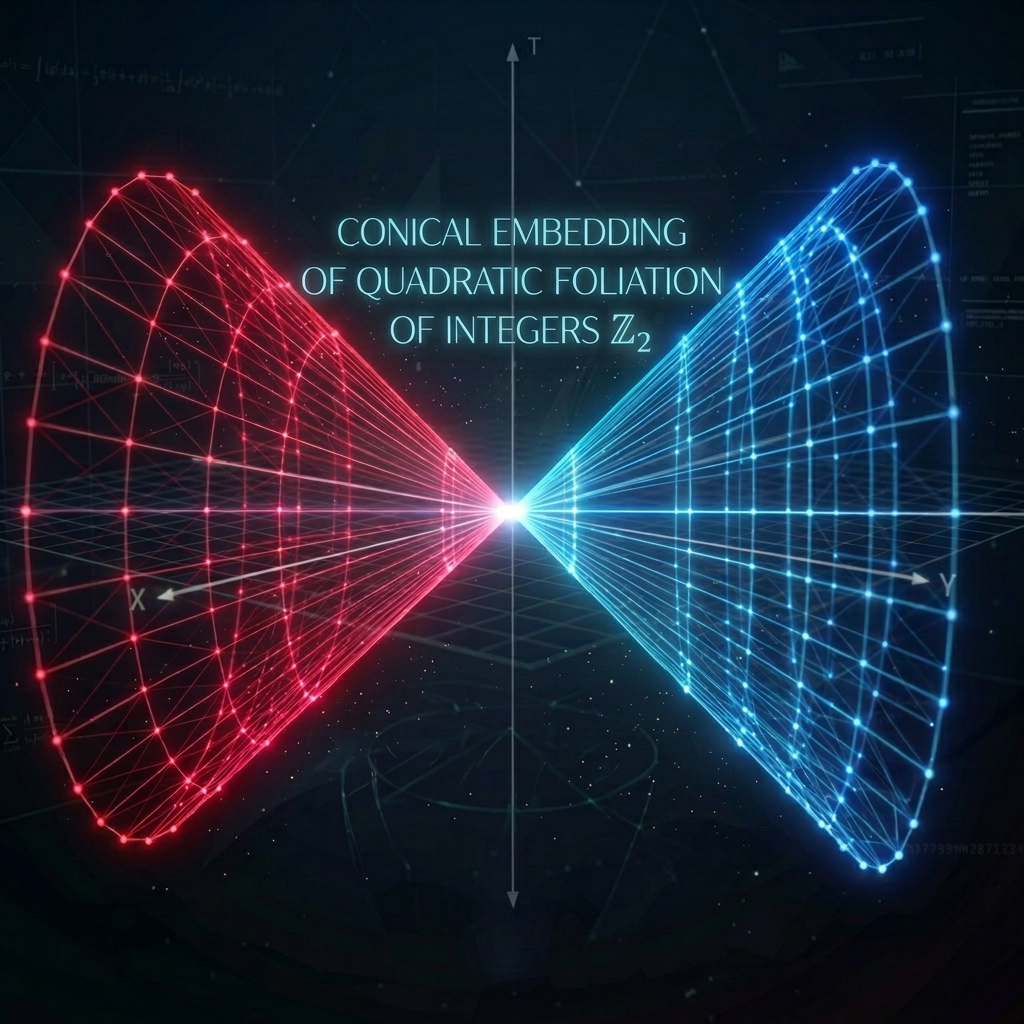

I believe that mathematics is one way the human mind can create concepts. In many ways mathematics plays a role that philosophy could have played in creating concepts that then can be used in the real world. It takes time for them to evolve and be used in the real world, but the real factory is mathematics.
The Geometry
of Integers
On the classical one-dimensional number line, the structural depth of an integer—its step distance from the origin—coincides identically with its scalar magnitude. Confined to a single degree of freedom, integers can translate only forward or backward along a single flat axis.
By partitioning the integers into horizontal power shells aligned along a central median leaf, every integer acquires two degrees of freedom and generates its own intrinsic two-dimensional coordinates across three canonical directional leaves.
Longitudinal depth along a structural leaf decouples from ambient scalar magnitude—endowing the integers natively with a geodesic metric, multi-valued arithmetic, three prime factorizations per integer, discrete curvature, and prime holography.
This portal presents the visual intuition with minimal equations. We invite you to read the full monograph for complete equations, proofs, and analytical derivations.
The Dimension Unfolder ($\mathbb{N}_1 \to \mathbb{N}_2 \to \mathbb{N}_3$)
Shells & The Four-Way Leaf Intersection
Every integer $n \in \mathbb{N}_m$ sits at the unique four-way intersection of one Horizontal Shell $S_{k,m}$ and three directional Leaves: Left ($\lambda=0$), Vertical ($\lambda=1/2$), and Right ($\lambda=1$).
Bounded by consecutive $m$-th powers $[k^m, (k+1)^m-1]$, indexed by shell $k = \lfloor\sqrt[m]{n}\rfloor$ and intra-shell residue $r = n - k^m$.
Tracks constant distance $g_l$ from the left boundary $k^m$, descending from birth shell $k_0(g_l)$ with local depth $d_l = k - k_0(g_l)$.
Parallel to the principal vertical leaf $V_{0,m}$: signed offset $g_v$ from the shell median and local depth $d_v = k - k_0(g_v)$.
Mirror image $\sigma_m(L_g) = R_g$ preserving distance $g_r$ from the right boundary $(k+1)^m-1$, with depth $d_r = k - k_0(g_r)$.
Just as Cartesian projection reads off abscissa and ordinate, tracing $n$ backward along its three leaves to their boundary roots extracts $(g_\lambda, d_\lambda)$. See Section 2 of the full paper for closed-form parameterizations.
Column 1 records the Shell coordinates $[k, r]^\top$ ($n = k^m + r$). Columns 2–4 record the Leaf coordinates $[g_\lambda, d_\lambda]^\top$ along Left ($\lambda=0$), Vertical ($\lambda=1/2$), and Right ($\lambda=1$), where $g_\lambda$ is the leaf generator at birth shell $k_0$ and $d_\lambda = k - k_0$ is the local leaf depth.
Peano Addition Along 2D Foliated Leaves
Discrete Transport & 1-Zigzag Chebyshev Geodesics
Moving an integer $n$ by $s$ shells along its resident $\lambda$-leaf via $\nabla_{\lambda,m}(n, s)$ preserves its leaf generator $g_\lambda$ and turns the lattice into a Chebyshev metric space $\delta_m(x,y) = \max(\Delta k, |\Delta g_v|)$.
Non-Overshooting 1-Zigzag Geodesic Router in $\mathbb{N}_2$
Foliated Addition, Subtraction & Multiplication
In $\mathbb{Z}_m$ ($m \ge 2$), addition ($\oplus_m$), subtraction ($\ominus_m$), and multiplication ($\otimes_m$) unfold into directional triads $\lambda \in \{0, 1/2, 1\}$ where $a$ is the geometric leaf-anchor and $b$ is the kinematic driver.
Advancing along $a$'s leaves by $b$ steps differs from advancing along $b$'s leaves by $a$ steps: $2 \oplus_2 3 = \{17,20,23\} \neq 3 \oplus_2 2 = \{11,13,15\}$, and commutative products $(a \otimes_m b) \cap (b \otimes_m a) = \emptyset$ are always disjoint.
Across the entire infinite hierarchy $m \ge 2$ and all $2 \le a < b$, the prime $31 \in S_{5,2}$ is the unique cross-direction commutative additive intersection: $(3 \oplus_2 4) \cap (4 \oplus_2 3) = \{\mathbf{31}\}$.
On the reflected double-lattice $\mathbb{Z}_m$, whenever an inward subtraction step exceeds a leaf's local depth $d_{\lambda,m}(|a|)$, the trajectory bounces across the origin $0$ into the opposite half-lattice $\mathbb{Z}_m^{-\varepsilon_a}$.
Foliated Triad Calculator ($\oplus_m, \ominus_m, \otimes_m$)
For foliated exponentiation, Euclidean division, modular congruence, and the proofs of Theorems 3.1–3.7, see Section 3 of the full paper.
Three Prime Factorizations per Integer & Goldbach Coupling
Measuring divisibility by intrinsic leaf depth $d_{\lambda,m}(n)$ endows every individual leaf with an autonomous copy of the Fundamental Theorem of Arithmetic.
Along any fixed leaf, the local depth map is isomorphic to $(\mathbb{N}^*, \cdot)$. An integer $q$ is a Local Leaf-Depth Prime ($q \in \mathcal{D}_{\lambda,m}$) whenever its intrinsic leaf depth $d_{\lambda,m}(q)$ is prime, giving each integer 3 distinct canonical factorizations across $\lambda \in \{0, 1/2, 1\}$.
In $\mathbb{N}_2$, the Left and Right local depths sum to $k$ (for $r$ even) or $k-1$ (for $r$ odd). An integer $x \in S_{k,2}$ is simultaneously a Left and Right leaf-depth prime iff $(d_{0,2}(x), d_{1,2}(x))$ forms a Goldbach two-prime partition of $k$ or $k-1$.
Because $\min(d_{0,2}, d_{1,2}) = \lfloor d_{1/2,2} / 2 \rfloor$, a prime minimum $\ge 2$ forces $d_{1/2,2} \ge 5$, ruling out $(2,2,2)$. The minimal Triple Leaf-Depth Prime in $\mathbb{N}_2$ is the central vertical leaf integer $x = 30 \in S_{5,2}$ with depths $(2, 5, 2)$.
The Multi-Foliation Factorization Prism ($\mathbb{N}_1, \mathbb{N}_2, \mathbb{N}_3$)
The $m = 1$ Peano Correspondence Principle
At the degenerate boundary $m=1$, lateral generators, discrete holonomy, and curvature vanish identically; the integers lose their second degree of freedom and classical Peano arithmetic is restored.
Four Foundational Questions Beyond the Flat Line
What is the natural axiomatization of a "foliated ring" or "foliated module" when single-valued commutativity is replaced by directional triads and holonomy commutators?
In the continuum limit of $\mathbb{Z}_m$, how do discrete transport operators transition into directional covariant derivatives and continuous curvature two-forms on $\mathbb{R}$?
Since circular periodicity is already native to the closed conical shells of $\mathbb{Z}_2$, can $\mathbb{C}$ emerge directly from helical transport without adjoining an extrinsic $i = \sqrt{-1}$?
Does the native $(1+3)$ operational structure of $\mathbb{Z}_m$ (1 shell depth + 3 non-commuting self-shift operators across Left, Vertical, and Right leaves) provide an arithmetic precursor to Hamilton's quaternions $\mathbb{H}$?
Leave a Comment & Subscribe
We welcome your thoughts, mathematical questions, and reflections on "Geometry of Integers". Share a comment below or send it directly to the author.
Subscribe to New Mathematical Concepts
Receive notifications when new monographs, interactive visualizers, and preprints by Dr. Hassan BALOUI are published.